| e-mail: matt@hhvferry.com |
| [HOME] [LINKS] [HENGIST] [HORSA] [VORTIGERN] [INDEX PAGES: A B C D E F G H I J K L M N O P Q R S T U V W X Y Z] |
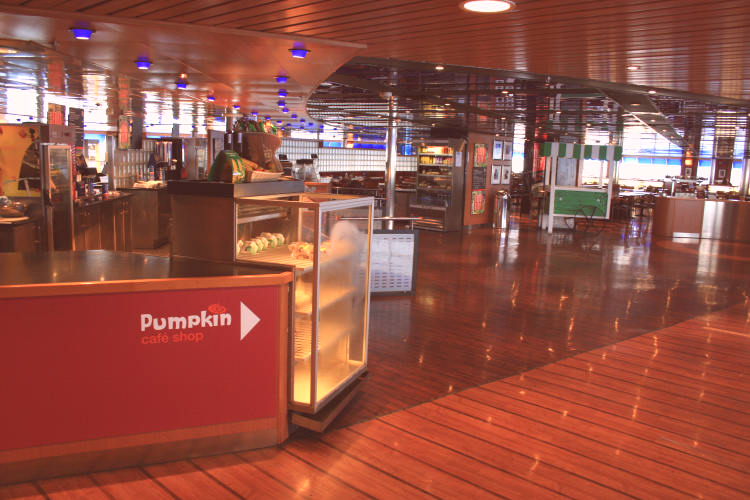
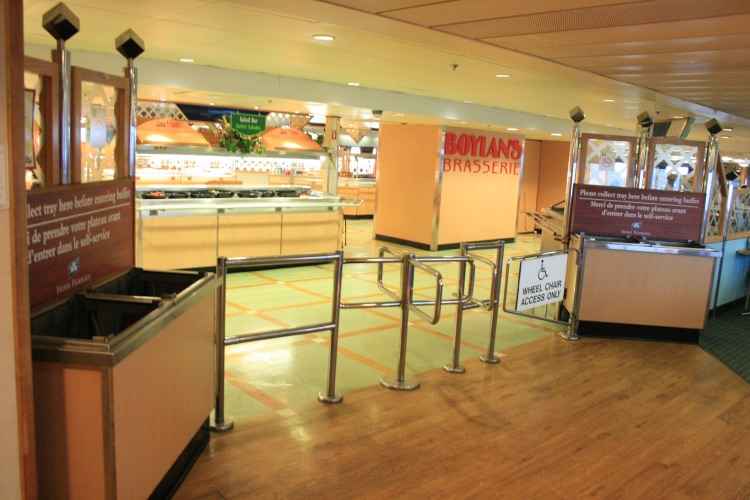
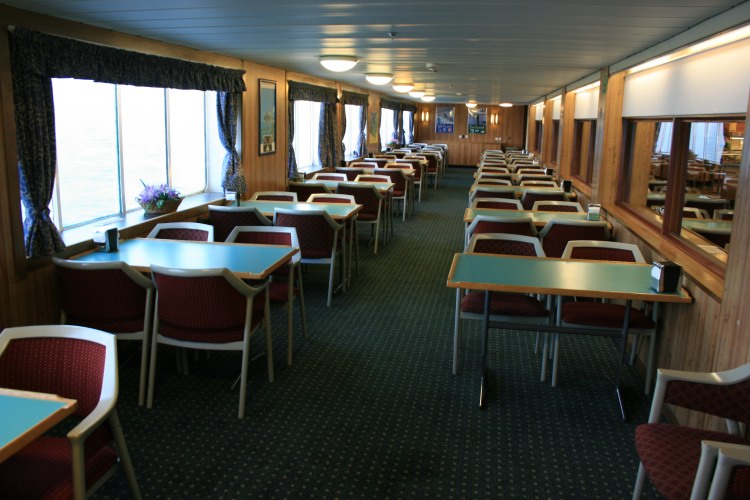
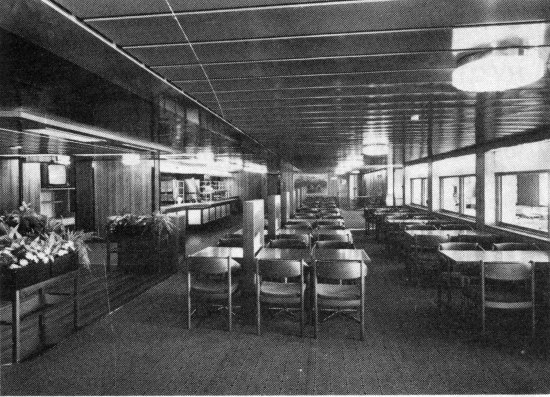
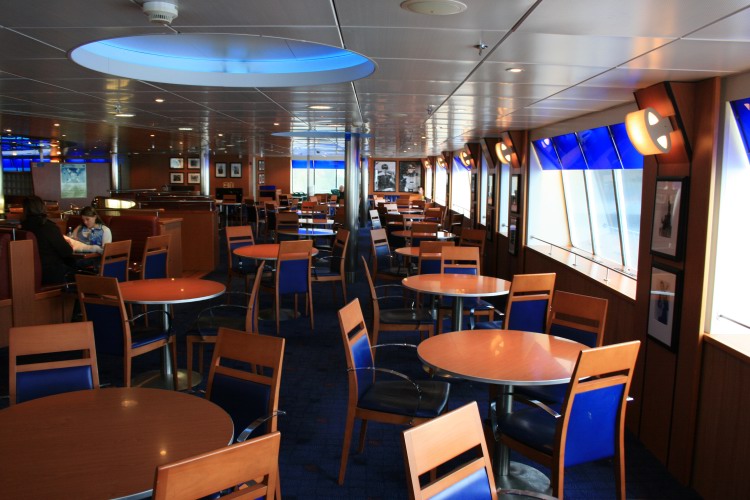
| The partitions noted in the Normandy's restaurant, now all removed on the Stena Europe, were one of the hallmarks of the ships as built and can be found in greatest supply in the last of the Irish ship's main passenger spaces, the aft Deck 8 cafeteria (Boylan’s Brasserie). This was once a rather elegant smörgåsbord restaurant with bar and dance floor before the servery area was converted for use as the Solent Self-Service in time for the ship’s transfer to the Southampton-Cherbourg run in 1991, and it remains largely unchanged from this guise today. The partitions are often cited as an example of innovative flexibility of design – with the sub-divided areas usable for conferences or private functions and so on - but they perhaps also serve to underline Sessan Linjen’s weakness against Stena when they were ordering their ships. Sessan's insecurity and Stena’s financial wealth were neatly juxtaposed in their competing orders (Stena’s pair finally emerged as the delayed Stena Danica and Stena Jutlandica of 1983); by specifying those 400 cabin berths plus the various multi-functional rooms, Sessan hedged its bets, making the ships suitable for their Travemünde overnight service with the presence of the cabins making the later conversion to fully-fledged overnight ships much more straightforward. The ‘Danica’ and ‘Jutlandica’ on the other hand were pure day ships, with just a small selection of cabins beneath the vehicle decks for use by truck drivers. Stena could afford to order almost simultaneously a quartet of huge overnight ferries in their own right and didn’t need to compromise the design of their Frederikshavn ships. [Report continues below] |
| STENA EUROPE & NORMANDY January 2007 All 2007 pictures © matt@hhvferry.com |
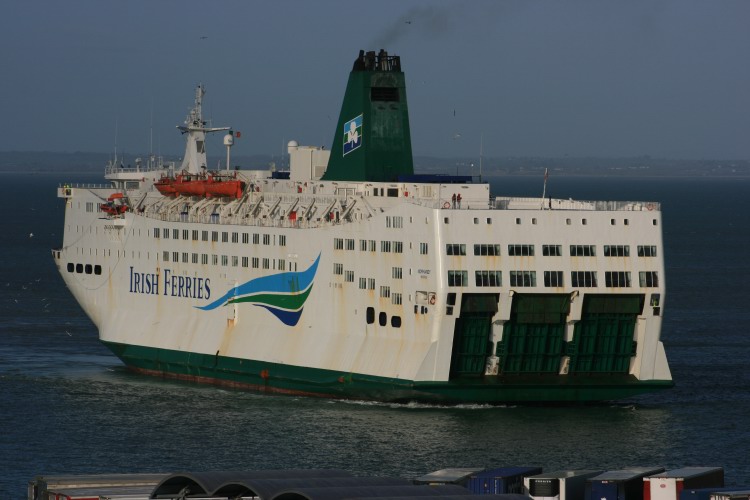
| Top: A rather weatherbeaten Normandy reversing onto her berth at Rosslare. |
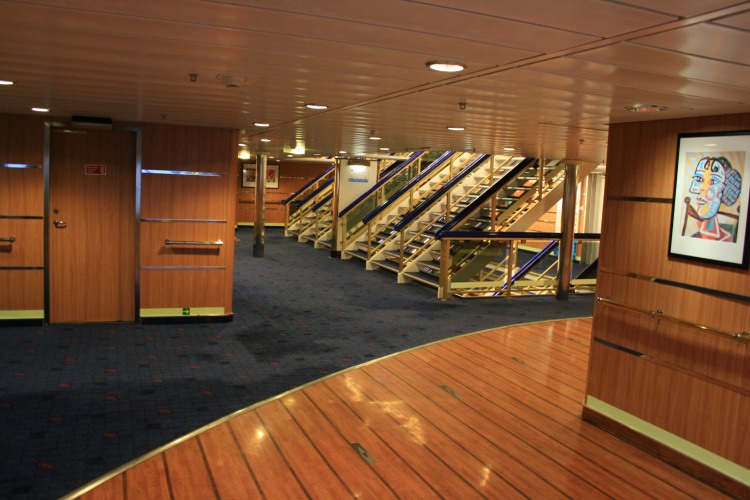
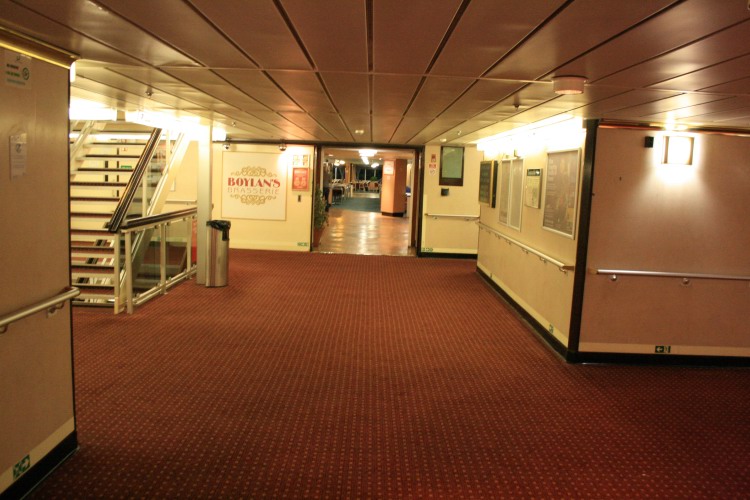
| Above and below: The aft Deck 8 lobbies on the Stena Europe (above) and Normandy (below). |
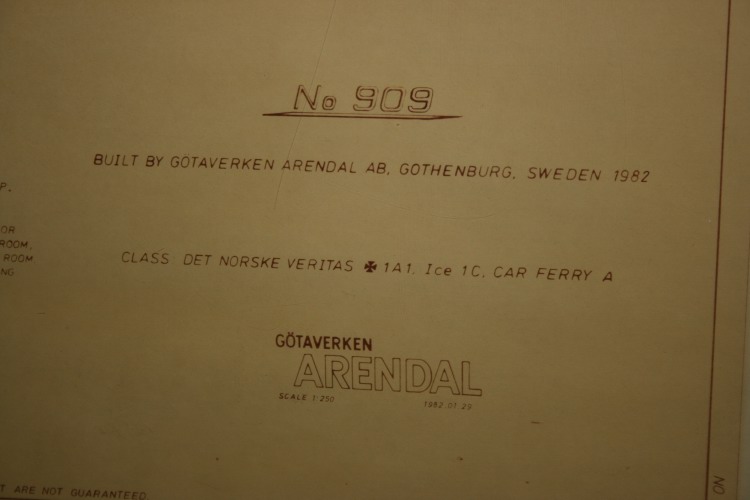
| Above: In this lobby on board the Normandy a section of an original GA plan can still be found, referring to the ship simply as "No. 909", the yard number by which the ship was known for a prolonged period as Stena pondered what to do with the incomplete and still un-named ship they had acquired along with Sessan Linjen. |
 |
 |
 |
 |
 |
 |
 |
 |
 |
 |
 |
 |
 |
 |
 |
| Returning to the present, the denouement of our outbound Normandy crossing was the disembarkation of foot passengers from the car deck. The little minibus was stuck right at the back of the upper level, so would inevitably and rather tiresomely be pretty much the final thing to be unloaded. As if that wasn’t bad enough, the bus was filled to bursting with passengers and it was soon found that we had no driver and that the main sliding door which had been closed for disembarkation could only be opened from the outside. Adding to an almost comical scene was the presence of a near-hysterical lady who suffered from claustrophobia. Eventually one of the more nimble occupants of the vehicle somehow slithered through the divide into the drivers seat, exiting the bus and opening the main door from the outside. It was by this stage about an hour after the ship had arrived in port with still no sign of a driver or of a crew member who seemed interested in summoning one. The final straw was when it became apparent that the ship was otherwise empty of vehicles and was now loading for the return to Pembroke Dock. With no help in sight and those occasional crew members who walked past either unable to understand or not interested, several passengers, including ourselves, made the decision to walk off the ship under their own steam. In the event this proved an astute move as, despite the difficulties of negotiating the dark marshalling yards and sidestepping lorries and speedily driven drop trailers, the minibus was not seen emerging from the ship until we were already climbing the hill to our hotel for the night. [Report continues on next page] |
 |
 |
 |
 |
 |
 |
 |
 |
| Above: The aft restaurant on board the Kronprinsessan Victoria in 1981 showing the distinctive internal window arrangement (right) and the vast central smörgåsbord servery area (left). |
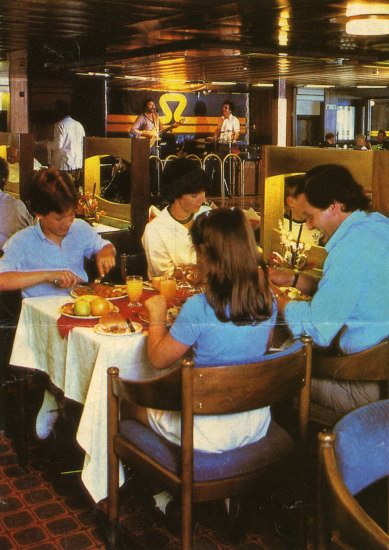
| Above: A section of the restaurant on board the St Nicholas in 1984 showing the dance floor and bandstand in the background. This was just after the launch of Sealink's new look and the new logo was popping up all over the place. |
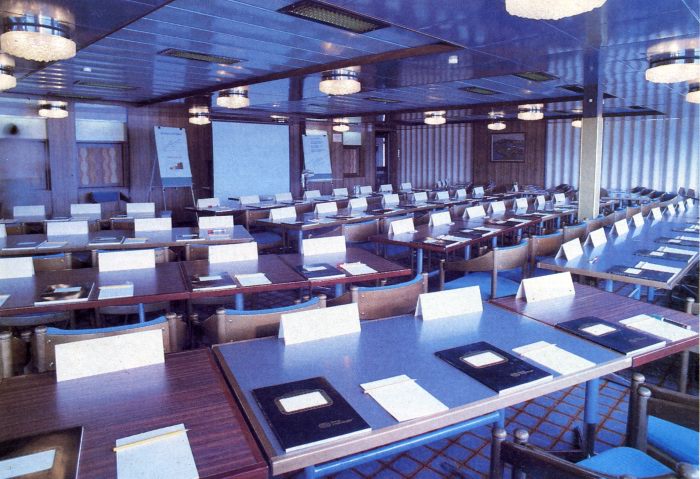
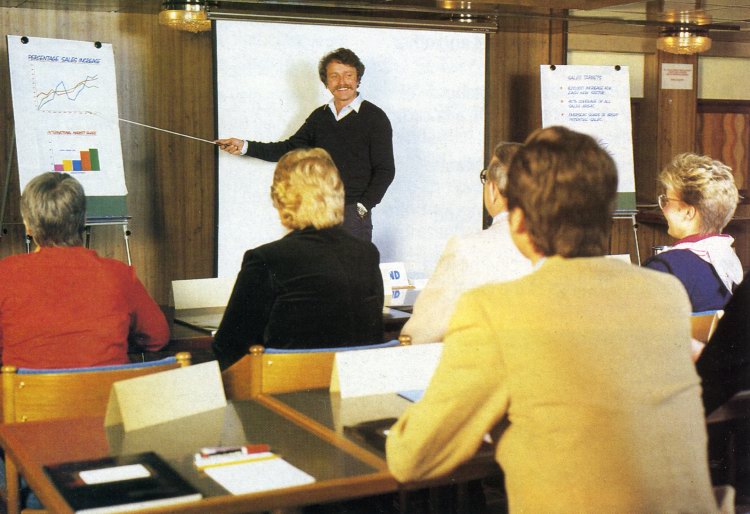
| Above: An interesting view of one of the aft sections of the restaurant on the St Nicholas in 1985 with the partitions pulled across to create a space suitable for conference use. For a period Sealink were very committed to making a success of this potentially lucrative business, and the company produced some lavish brochures including some rather over-posed scenes from on board their flagship. |
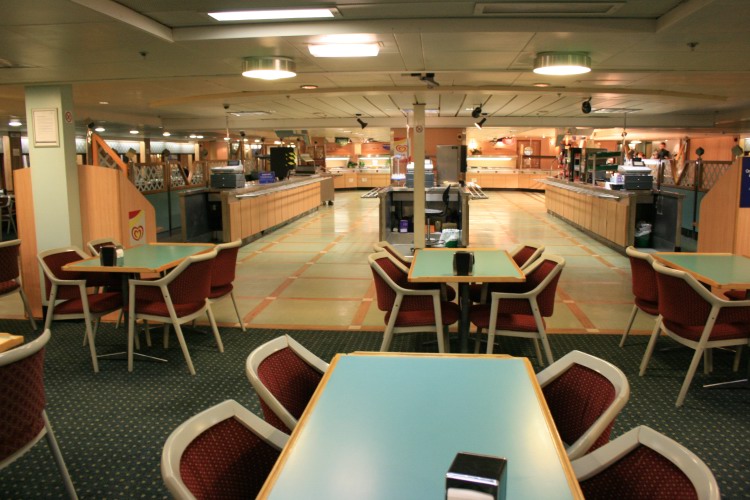
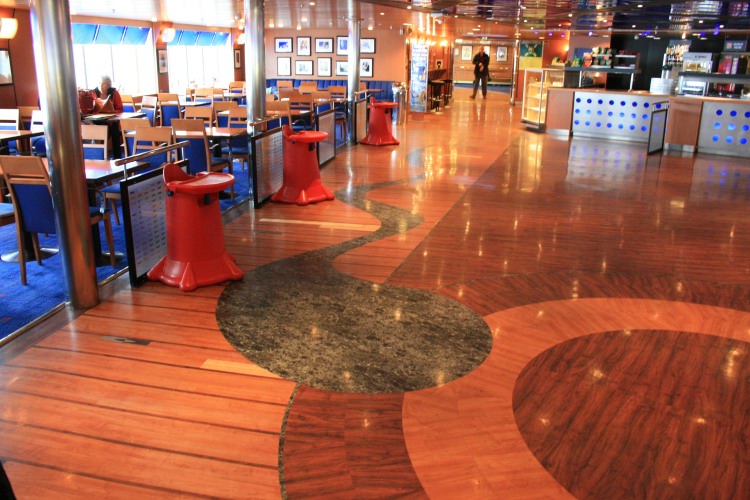
| Above and below: Looking across into the food servery areas in what is now Food City on the Stena Europe (above) and Boylan's Brasserie on the Normandy (below) in 2007. |
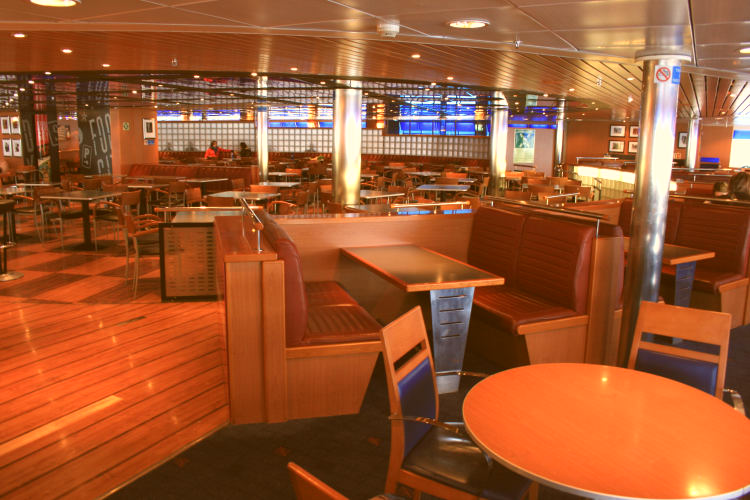
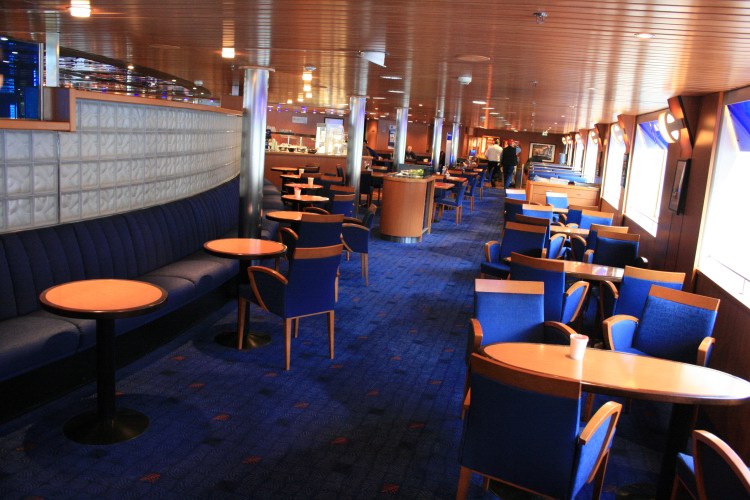
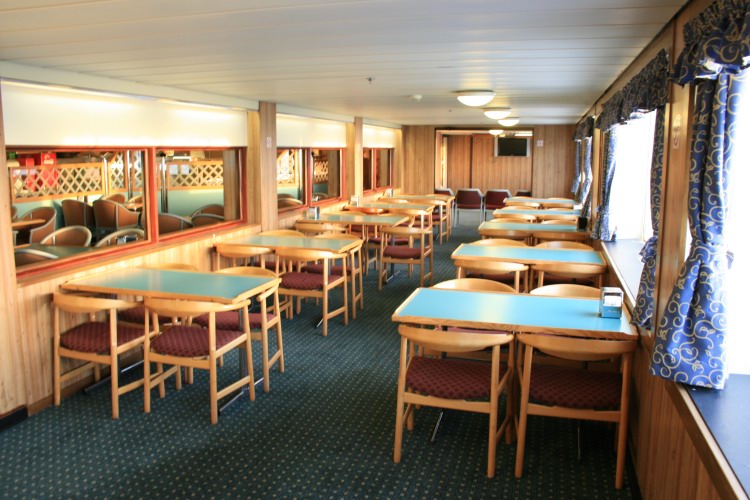
| Above and below: Whereas the Stena Europe (above) has completely lost the original system of retractable partitions and internal windows, the Normandy (below) retains them in full. Both these views are looking forward on the port sides of the two ships. |
| Above and below: The centre sections of Food City (above) and Boylan's Brasserie (below). |
| Above and below: On the starboard side, the Stena Europe (above) has a completely separate Truckers' Club area, accessed via a dedicated staircase from the main lobby on the deck below. The equivalent space on the Normandy is seen below - this is now simply an additional part of the Brasserie's eating area although coincidentally this section was designated the Commercial Driver's Restaurant during the ship's Western Channel days. |
| Above: A final view of Food City, this time looking across at the stern of the space. |
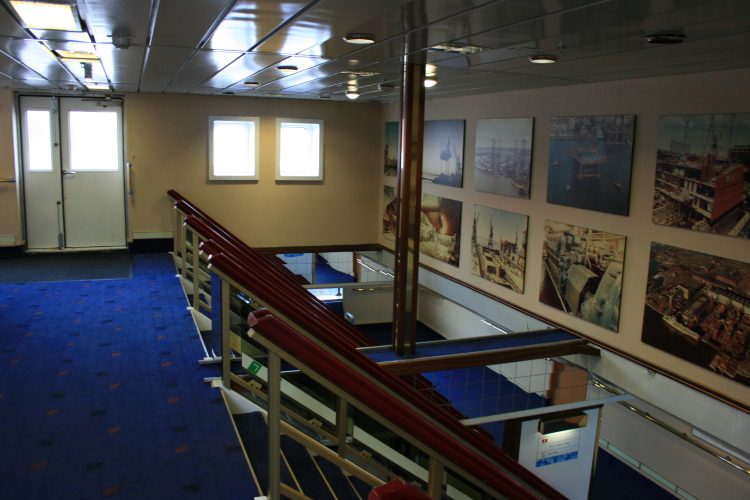
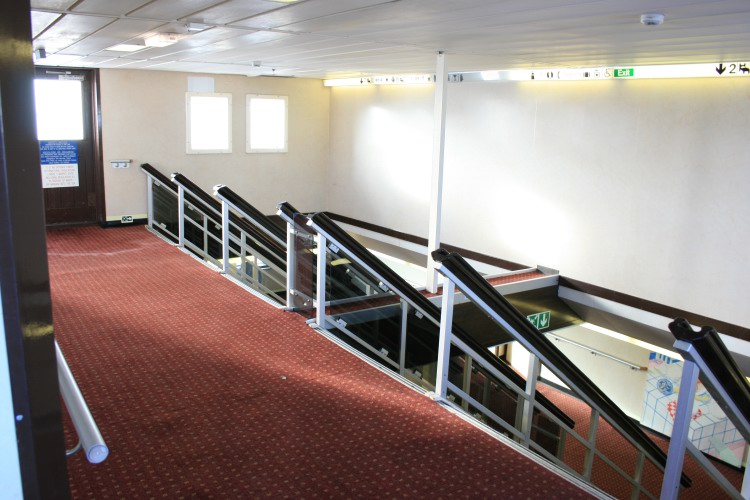
| Above and below: One final area of interest are the uppermost staircase hallways on Deck 10 - here, the 'Europe' (above) retains a series of large pictures of her construction, launching and early days in service, most of them in basic Sessan Linjen colours. The Normandy's equivalent bulkheads are completely bare (below). |
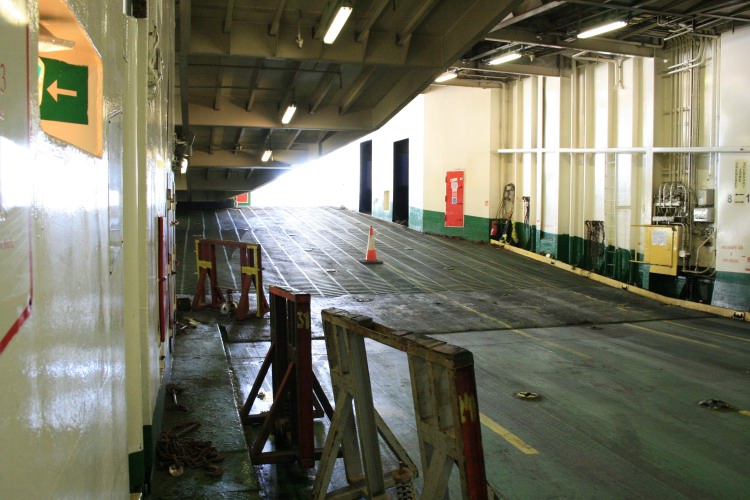
| Above: Looking aft on the Normandy's upper car deck. The additional passenger accommodation at this level added by Sealink is contained within the container-like construction to the left. |
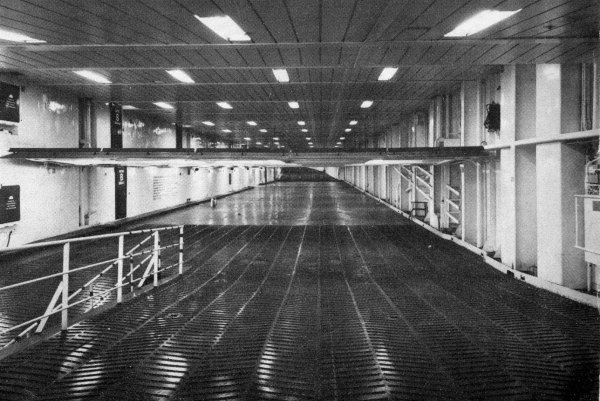
| Above: The upper vehicle deck as it was on the Kronprinsessan Victoria when she entered service. |
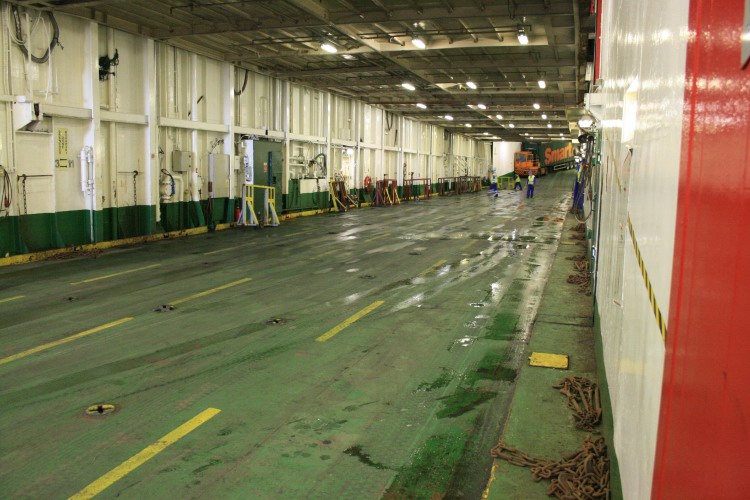
| Above and below: Looking forward (above) and aft on the Normandy's lower vehicle deck. |
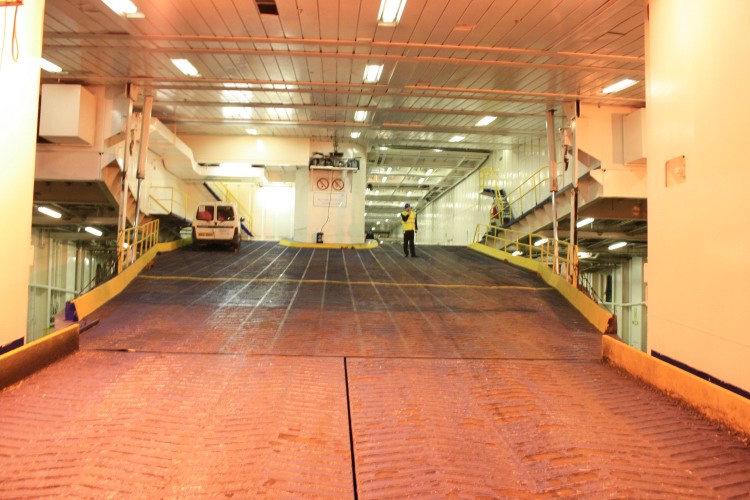
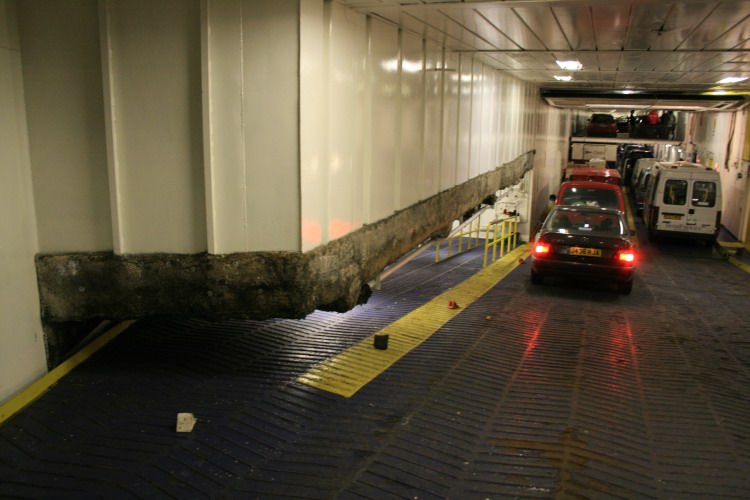
| Below: Disembarking from the Normandy, this view demonstrates the triple-ramp arrangement where the central ramp leads to the upper freight deck and the two side ramps to the lower deck. |