| e-mail: matt@hhvferry.com |
| [HOME] [LINKS] [HENGIST] [HORSA] [VORTIGERN] [INDEX PAGES: A B C D E F G H I J K L M N O P Q R S T U V W X Y Z] |
| The main preoccupation as we left Nador for those not ranged on the aft decks watching was evidently communication with God although there was no call to prayer on this, Western-controlled ship. As a naïve outsider, I did wonder how one could sensibly get a good bearing on East whilst the ship used her bow thrusters to good effect and rotated 180 degrees in the harbour before heading out of port. Perhaps there are rules about such things.
Having sailed on each of the regular Almeria-Nador ships over the past two years I would have to say the Wisteria is by far the most comfortable. The Berkane of COMARIT perhaps comes closest, but has areas of gross decrepitude and in some places hasn’t been touched since she entered service with SNCM in 1976. Ferrimaroc, now under the control of Acciona Trasmed, have upgraded significantly since their days running the Scirocco and the Mistral (now COMANAV’s Mistral Express) and appear to have consciously repositioned themselves towards a more Western clientele and slightly away from the Moroccan passengers for which they once catered almost exclusively. If they can hold onto the Wisteria, and can keep her (or a decent replacement) in good condition there seems no reason to think they can’t continue to be successful, although whether Ferrimaroc will be further submerged into the parent company remains an open question. We arrived the next morning to find Almeria still shrouded in darkness; as we moved across the harbour however, the shape of the Wisteria’s former Brittany Ferries fleetmate the Giulia d'Abundo (ex-Quiberon) could be made out, clearly out of service and at a lay-up berth away from the main ferry terminal. Chartered in March by Euroferrys from her current owners Medmar for use on a new route (for them) between Almeria and Nador, Euroferrys were promptly also taken over by Acciona Trasmed and rather than duplicating the efforts of the Wisteria, the ship has instead spent most of the Summer running on the Almeria-Al Hoceima run covered in previous years by the Sara I (ex-Djursland II). |
| MOROCCO, SEPTEMBER 2006 Part Two: Giulia d'Abundo 2006 pictures © matt@hhvferry.com |
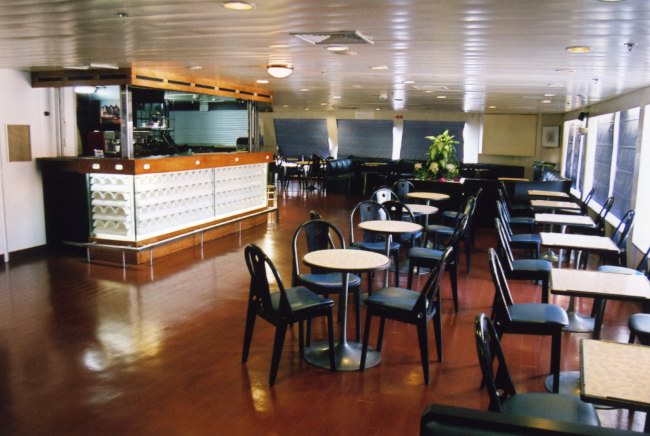
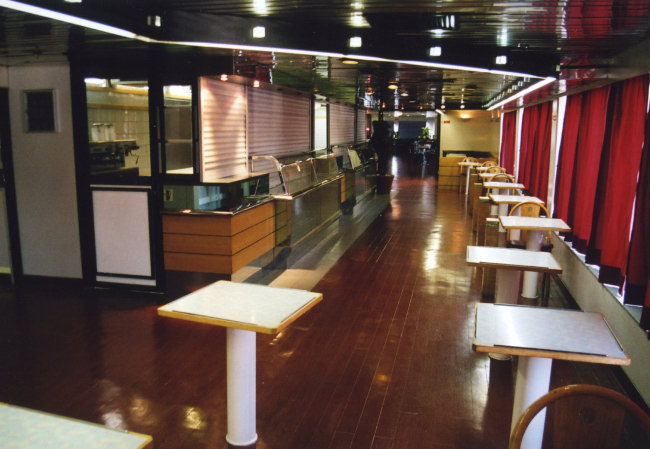
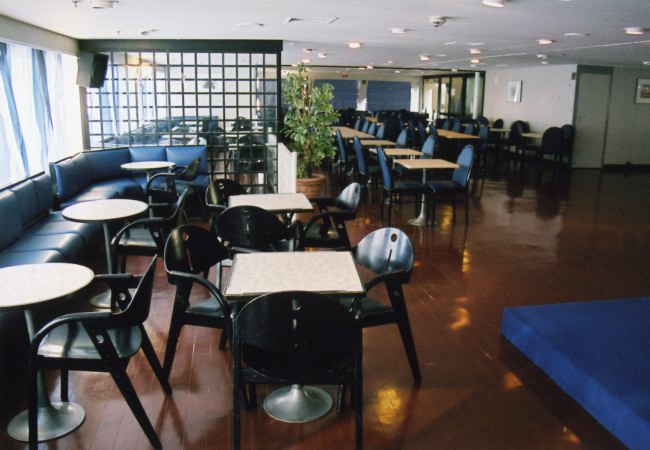
| Above and below: The forward bar (formerly 'Le Ponant'), above, and the adjacent lounge (formerly 'Le Sinagot' restaurant), below, on the Giulia d’Abundo. |
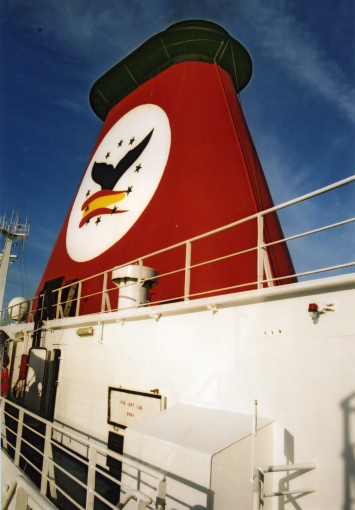
| Top: On board the Giulia d'Abundo. |
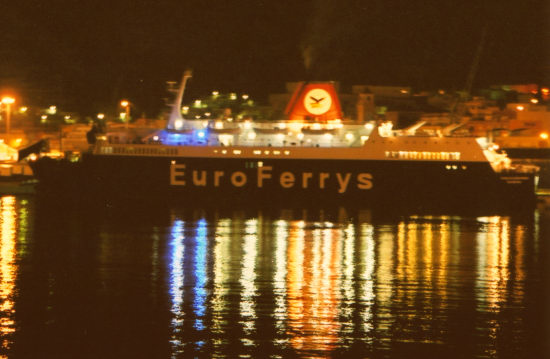
| Above: The Giulia d’Abundo, seen from the Wisteria at Almeria. |
 |
| We disembarked from the Wisteria and, as the sun rose, made our way through customs and into the harbour complex and towards the Giulia d’Abundo. By this time the ship was gloriously sunlit with the Alcazabar Castle on the hilltop behind the port providing a rather splendid backdrop. Although probably best-known as the Quiberon between 1982 and 2002, the ship originally entered service with Öresundsbolaget as the Nils Dacke between Malmö and Travemünde in 1975, having been ordered by Lion Ferry. Amalgamations followed with Trave Line in 1976 and then TT Line in 1980, and in 1982 the ship was chartered out to Brittany Ferries.
We were welcomed aboard the ship by her master who swiftly agreed to let us have a look around. This was something of a surprise, but particularly welcome as we had just come off the ship’s former fleet-mate; in fact, it had been the Duc de Normandie which replaced the Quiberon on the Plymouth-Roscoff route in 2002. Onboard, just as the Wisteria is still largely the Duc de Normandie, so the Giulia d'Abundo is still very much the Quiberon. The largest change has been the bulldozing of the former 'Le Sinagot' restaurant on the port side of Deck 6 (adjacent to the bar) to become an additional lounge with a dance floor. Elsewhere, the shop has been closed off and most of the passenger areas have had their carpeting removed and replaced, rather unfortunately, with cheap-looking laminate flooring. Our guide, the ebullient ship’s purser regaled us with tales of the ship’s passengers during her time on the Moroccan routes – as with the Oujda, theft of fittings had been regular. This had extended to an (unsuccessful) attempt to remove the large TV sets from the twin cinemas aft on Deck 5; meanwhile he explained that several of the framed photographs from the cabin corridors had gone missing: presumably pictures of chateaux and the like are now gracing the walls of houses up and down Morocco. Quite what the future holds for the Giulia d'Abundo is unclear: although apparently on charter from Medmar until next year, she was not urgently required when we visited her and was apparently lying awaiting further orders. The Italian operations of Medmar themselves have contracted somewhat in recent years but it remains a possibility that, the lucrative charter complete, she resumes operations there. Although not in quite as good condition as the Wisteria, she is still in pretty good shape and would provide an excellent Summer charter option for operators across Southern Europe. |
 |
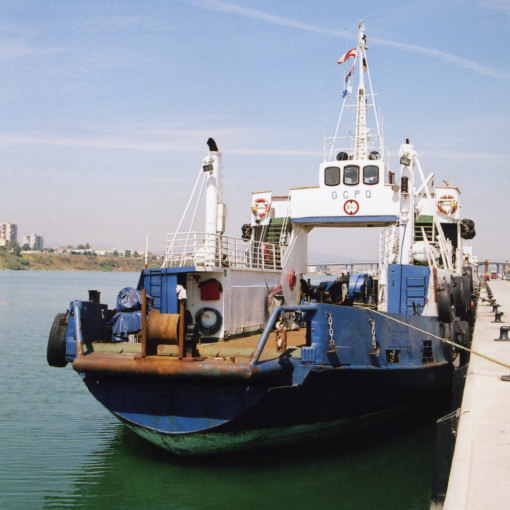
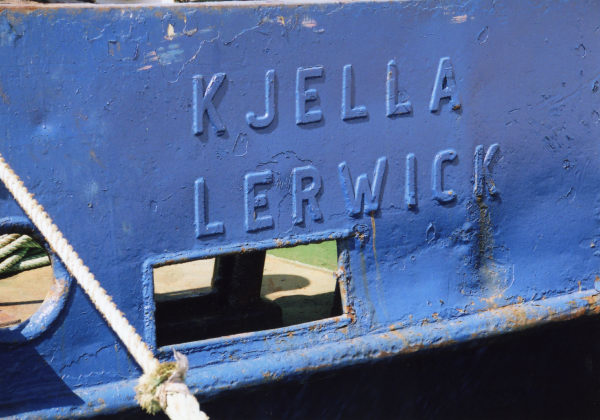
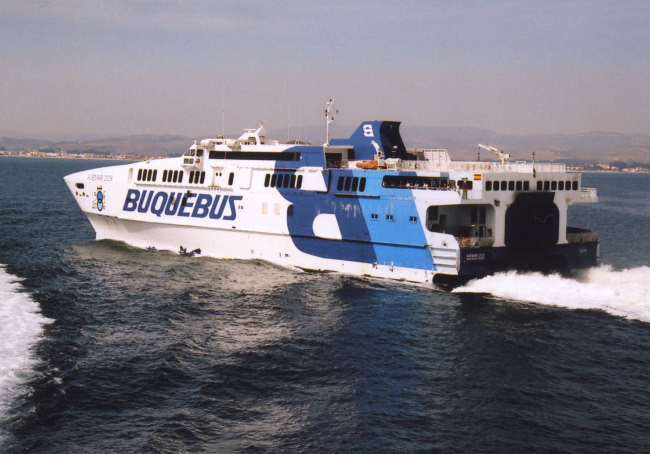
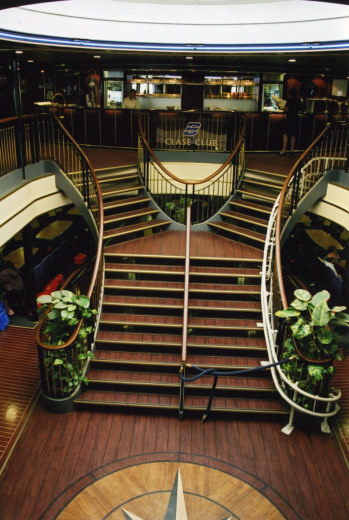
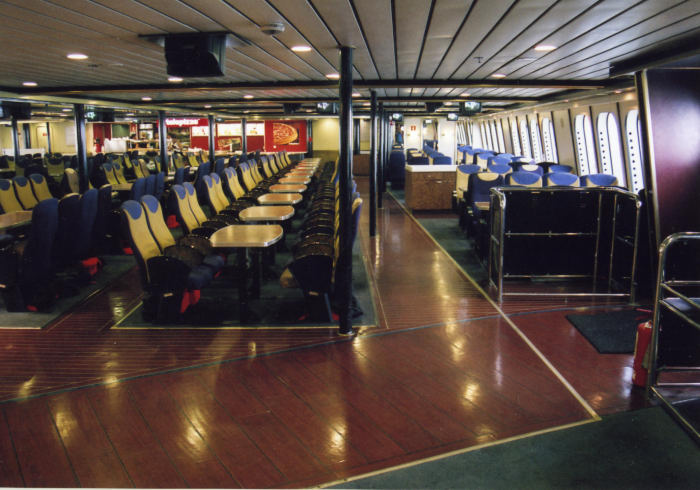
| The trip was rounded off by a quick visit to Algeciras, where the former Shetland Islands ferry Kjella can still be found. A quick day-return was made to Ceuta on the Euroferrys Pacifica and the Avemar Dos (ex-Superstar Express). Ceuta was charming enough, but the two ferries were typical Austals: comfortable but rather forgettable. However, it was particularly appropriate to sail on the latter ship, now heavily refurbished, after a trip that had become something of a Western Channel reunion. Morocco is slightly more exotic than Le Havre or Cherbourg and the passengers a little different from Cross-Channel booze-cruise or holiday traffic, but the ships themselves were mostly unchanged. And as long as there is an advert for Plymouth University in the lobby of the Wisteria or a painting of Henry VIII on the Oujda, these ferries will continue to make fascinating cultural contrasts all of their own. |
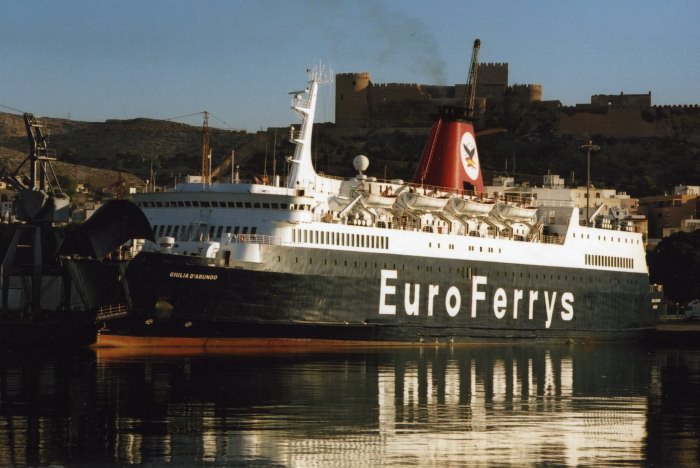 |
| Above: The Giulia d’Abundo at Almeria. |
 |
 |
 |
 |
 |
 |
 |
 |
 |
 |
 |
 |
 |
 |
| Above: Just aft of the bar can still be found the former Salon de Thé, 'Le Moulin à Mer'. As with most of the other main passenger areas, this space has received new laminate flooring but is otherwise largely unchanged from the ship's Quiberon days. More interior pictures on the Giulia d’Abundo can be found in the Quiberon section of the site. |
| Above and below: The one-time Norwegian ferry Kjella, latterly used by Shetland Islands Council, could be found laid up in the inner harbour at Algeciras. |
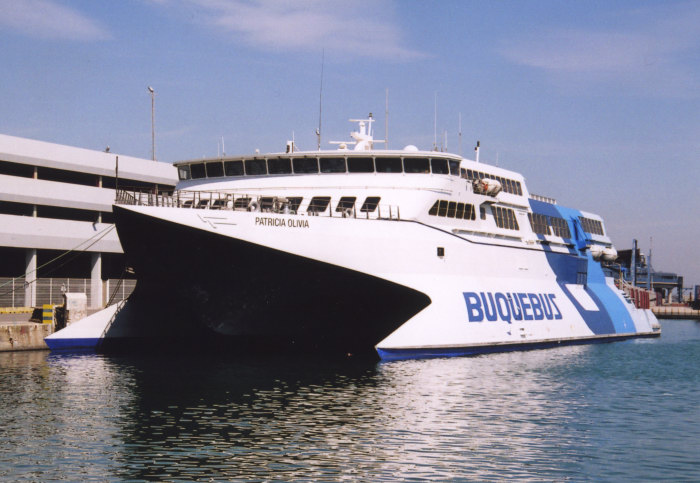
| Above: Buquebus's Patricia Olivia seen on her berth in Algeciras. |
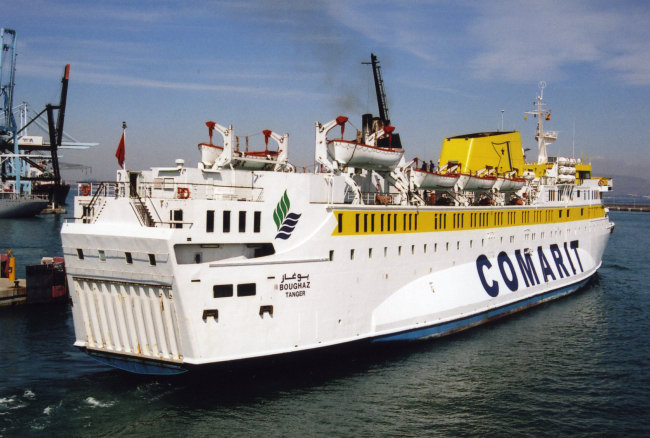
| Above: The Boughaz (ex-Viking 5/Bolette) seen departing for Tangier. |
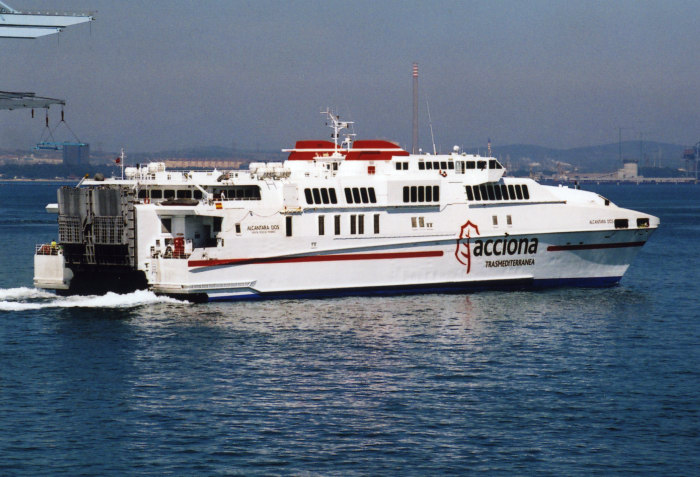
| Above: The Alcantara Dos was originally ordered by Sea Containers to become the SuperSeaCat France, but was rejected as not meeting speed requirements. She was then promoted by Stena Line as the Stena Lynx IV for use between Newhaven and Dieppe but again never entered service. Finally the vessel was used by Cat-Link (as Cat Link III) and latterly by Tallink as Tallink AutoExpress before being sold to Acciona in 2006. She is seen here departing Algeciras. |
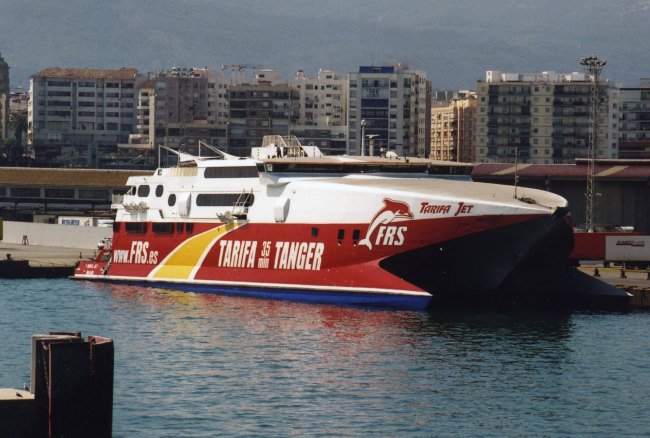
| Above: The Tarifa Jet, formerly SNAV's Sicilia Jet, Sardinia Jet and finally Pescara Jet prior to sale to FRS in 2006. |
| Above: The Atlas (ex-Stella Scarlett/Gelting Syd) laid up in Algeciras. |
| Above: The Avemar Dos (ex-Superstar Express). |
| Above and below: Two views on board the Avemar Dos. The ship has been fairly heavily refitted by Buquebus for her present service. |