| e-mail: matt@hhvferry.com |
| [HOME] [LINKS] [HENGIST] [HORSA] [VORTIGERN] [INDEX PAGES: A B C D E F G H I J K L M N O P Q R S T U V W X Y Z] |
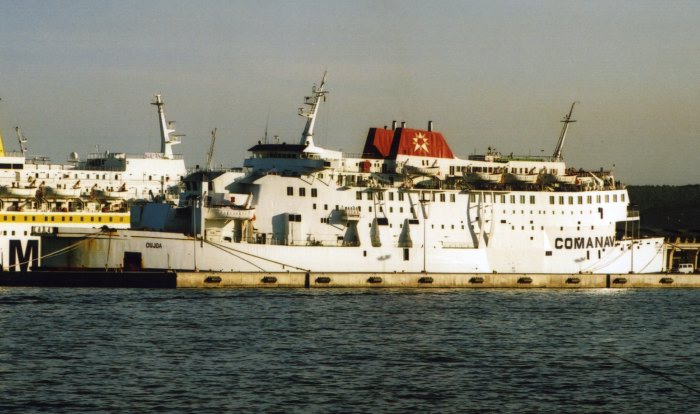
| With our meals finished, it was time to try out the ship’s entertainment. When we visited the Tadla in Genoa back in May, the crew had regaled us with tales of how the male Moroccan passengers would dance the night away on that ship’s sailings from Italy to Tangier (their wives politely sitting around watching). On the Oujda the live band had set up shop at the forward end of the main lounge, but, despite their best efforts, the passenger load on this ship clearly wasn’t interested in boogying the night away. The most lively activity instead seemed to be the jostling in the queue for the Moroccan passport official who was busy beating off a crowd desperate to get their passports stamped – seemingly these people did not realise they had another 30 hours to get all that sorted out!
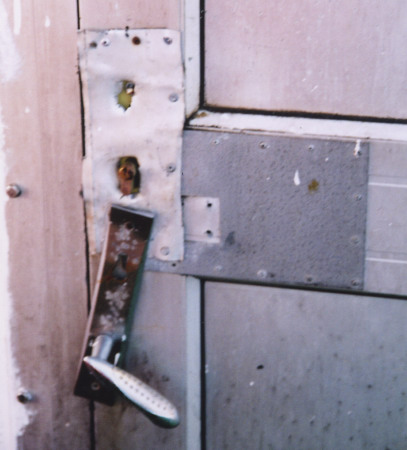
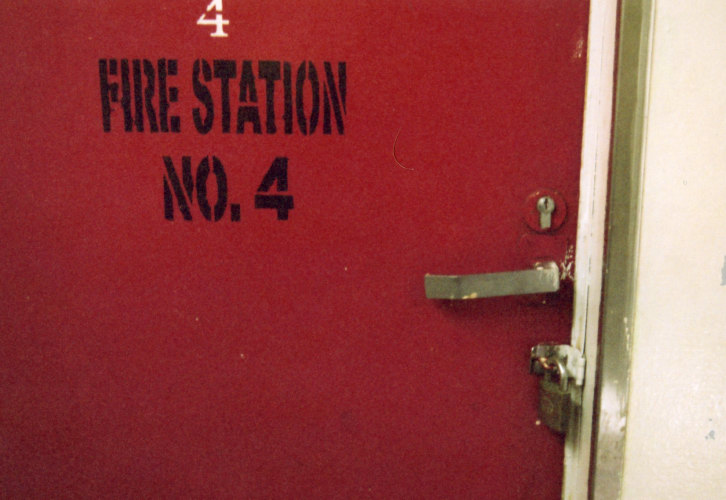
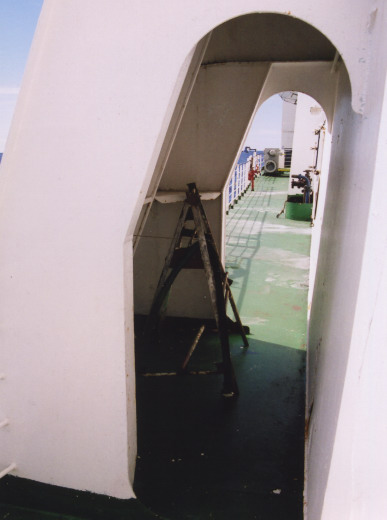
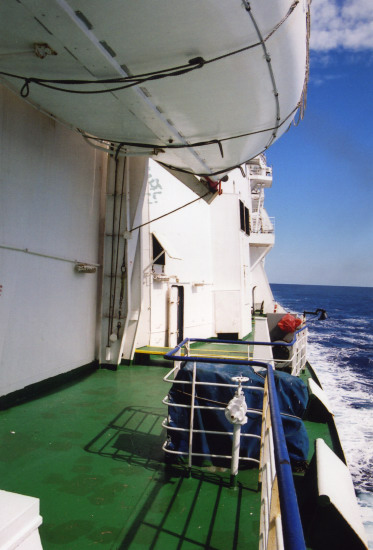
Fortunately, COMANAV do not operate a dry ship policy so, after a while in the bar and happily fortified we started to take a closer look at the state of the Oujda. At the aft end of Deck 7 the small outside deck area was home to a couple of caged budgies – on that first night as our ship slammed her way to Morocco, the birds seemed totally unperturbed and happily twittered away. Heading back inside, the door handle unfortunately came off in Richard’s hand – strangely the second time that had happened in two weeks, the Seafrance Renoir being the previous culprit. I guess they just don’t make door handles like they used to. After putting it all back together as best we could, we headed down the stairwells passing fire station no. 4 which could be seen carefully padlocked up – evidently the crew were confident there was no fire risk on this ship. The car deck was open at all times during the crossing and, at the forward end of the upper vehicle deck, access could be gained to the narrow deck areas on either side which are a legacy of the stretch where the new forward part of hull was wider than the original superstructure. These would provide a secluded place to catch a snooze the next day, partially sheltered by one of the additional lifeboats added in that conversion. Happily reassured that the ship seemed to be as secure for sea as possible we made our way to bed. |
| MOROCCO, SEPTEMBER 2006 Part One: Oujda (continued) Sète - Nador 2006 pictures © matt@hhvferry.com |
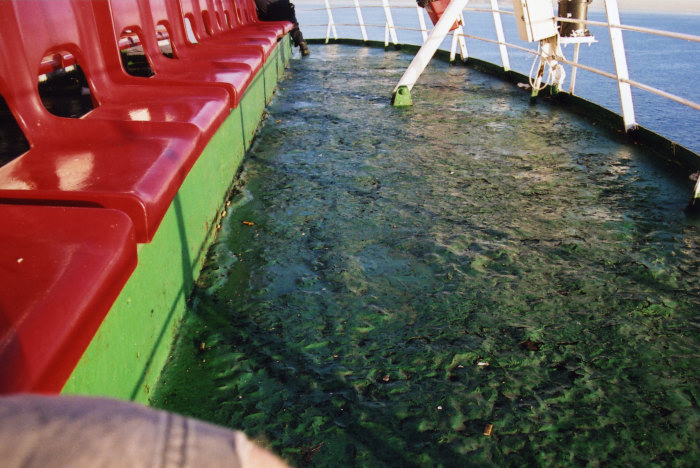
| Above and below: Down on the forward outside deck at the level of the upper vehicle garage. |
| Above and below: A couple of slight problems.... |
 |
 |
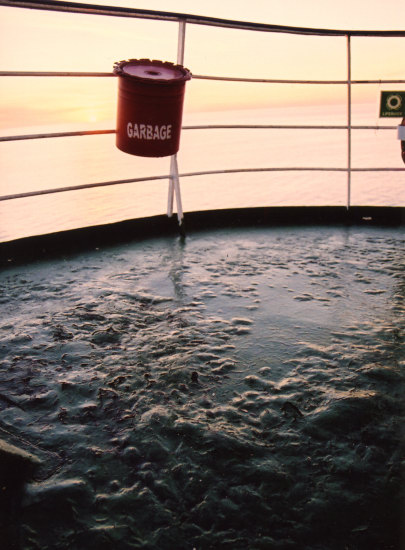
| Sunday was to be sent entirely at sea and a lie-in seemed altogether more appealing than reporting for breakfast. The sea had clearly calmed down significantly from the previous evening but at about 10 o’clock the ship’s peaceful rolling was interrupted by a cacophonous series of loud bangs, which sounded much like someone hammering on the pipes of the ship’s plumbing system. Taking this as a cue to get out of bed, a quick inspection of the showers rather made my mind up for me, and I decided to have a wash using the basin in the cabin rather than take my chances in the now thoroughly putrid-smelling shower block. Standing up on the aft deck the cause of all the hammering soon became apparent – the crew had taken the opportunity, late in the season, to deal with some of the ship’s paintwork and were tending to the deck rails, checking for any signs of peeling paint and removing huge offending chunks with hammers and chisels. Unfortunately they had much work to do and the deck was already well covered with the snowflake-like peelings. The state of the railings however was nothing compared to that of the deck itself. The only description for this is that, in places, the layers of paint appeared to have melted, resolidifying into a cracked, potholed mess. Looking at it close-up, you could be forgiven for thinking that you were looking instead at a small-scale 3D terrain map, and one covering fairly hilly terrain at that. Actually, the thought that the deck had melted might have had some grounding in reality as this ship operates in incredibly hot conditions during her current winter service as a Hajj pilgrim-ship and in areas not exposed to as much direct sunlight it was in fairly acceptable condition. |
 |
 |
 |
 |
 |
| After lunch we were invited up to the captain’s quarters; there, as we drank mint tea with the master, his two sons and the ship’s doctor, we discussed the ship, her future and COMANAV generally. Tactfully, we skirted round the issue of the Oujda’s owners El Salam and their preponderance of unsettling ship disasters. Bearing such sensibilities in mind, we had requested permission to take pictures when we had first come aboard and the captain, somewhat unexpectedly, now readily granted his authority. He explained however that he would prefer it if we took them after passengers had disembarked when we arrived in Nador the next day. Apparently this was company policy as COMANAV had encountered some problems with passengers getting upset about picture taking – usually men who thought people were photographing their wives. One’s mind briefly wandered back to that strange day in May 2003 when our good friend Bruce Peter was escorted off the company’s Tangier ship Al Mansour by the crew after inadvertently catching a gentleman in his viewfinder, the victim demanding the Port Police take stern and immediate action. Presumably it was this kind of indiscretion which had required COMANAV to put a policy in place.
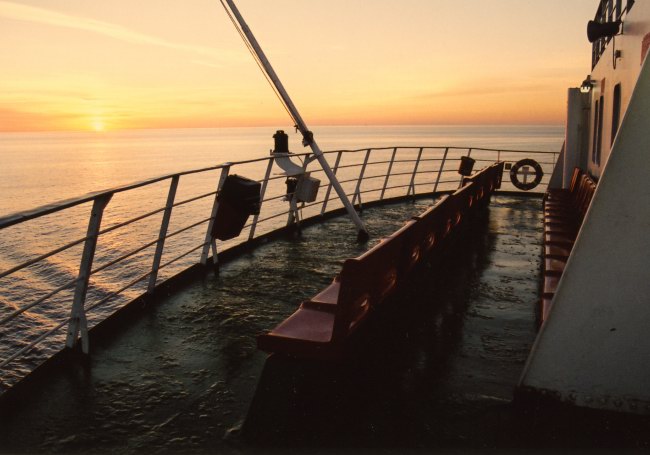
That evening, as I stood on the upper outside deck with a bright red sunset disappearing behind the Spanish coastline to starboard, I had one of those rare ferry moments. Happily disconnected from land, our ship ploughed her lonely furrow and, as the call to prayer came out over the ship’s loudspeakers once could contemplate a certain inner contentedness. Such pretentiousness was clearly inappropriate however and the Oujda knew it even if I didn’t and promptly discharged a large black smut onto my clean white t-shirt, provoking a most inappropriate expletive and disapproving stares from a dozen headscarf-wearing ladies. The moment lost, I headed back down to the grime below. We awoke the next morning to find the Oujda steadily approaching Nador. Pulling into the harbour, the Mistral Express was alongside whilst the Santa Cruz de Tenerife and Ciudad de Valencia could be seen at the Trasmed terminal in the neighbouring Spanish enclave of Melilla. As we manoeuvred onto the berth, a quite overpowering stink hit those standing on the outside decks: clearly whilst Nador port might have been developed significantly over recent years, in some ways underneath it is just the same as ever. After 36 hours on board our ship though I was quite ready to try something else and after taking our onboard pictures we disembarked. The Oujda would leave in the evening to return to France; although our sailing on her had been quite fascinating and very enjoyable, there was a sense of relief at the back of my mind as we made our way off the ship over the stern ramp. I was delighted that we had taken the chance to sail in her though as it seems inevitable that relatively respectable companies such as COMANAV, COMARIT and COTUNAV may begin to baulk at chartering ships from El Salam and that the Oujda may disappear forever to the Red Sea. Or, very possibly, join her fleetmates beneath it. |
 |
 |
 |
 |
 |
 |
 |
 |
| Above: The Oujda on her berth at Nador with COMARIT's Berkane behind. |
| Below: The sun sets on the Oujda... |
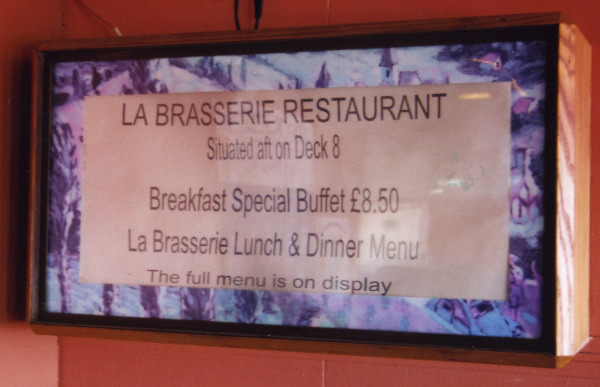
| Above: £8.50 for breakfast anyone? In COMANAV service meals are included in the price of your ticket. |
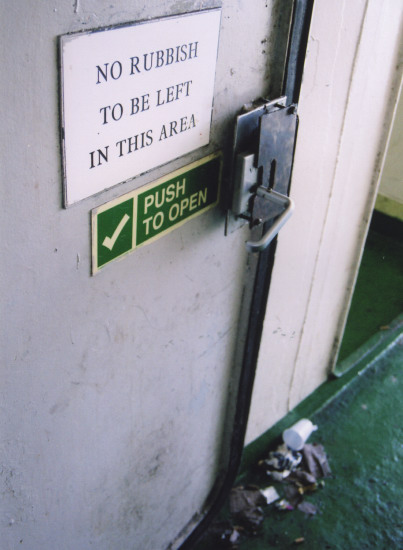
| Above: Perhaps the sign needs translating for it to be of any use. |
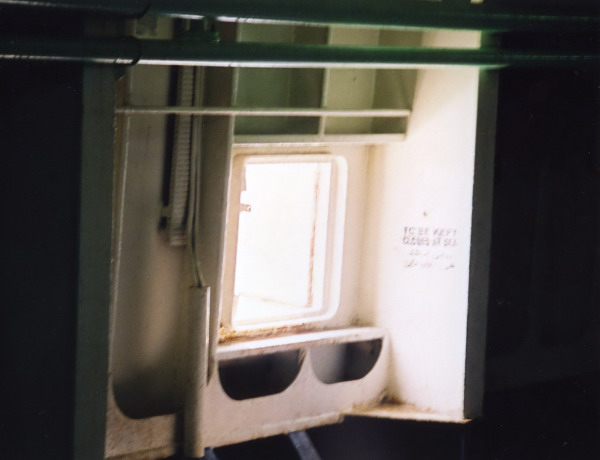
| Above: A scene on the vehicle deck; this sign does have an Arabic translation: it reads "To be kept closed at sea". Mmmm. |
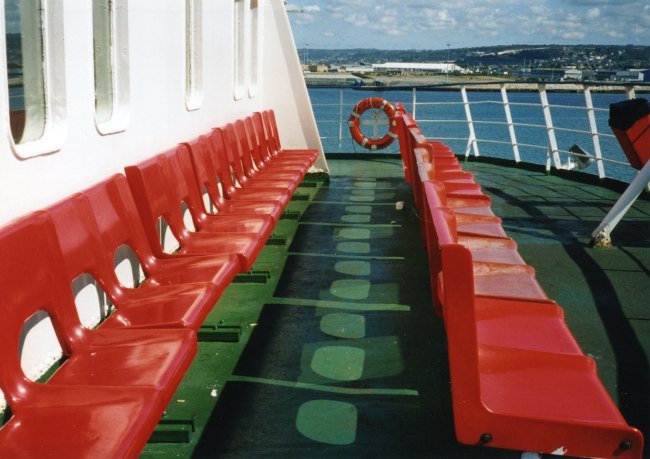
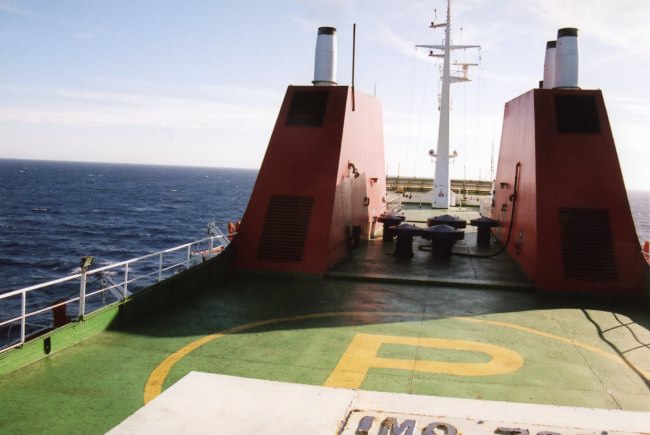
| Above and below: The beautifully maintained outside deck at the aft end of Deck 9. |
| Below: The same area on the Pride of Hampshire in her final days of P&O service in 2002. |
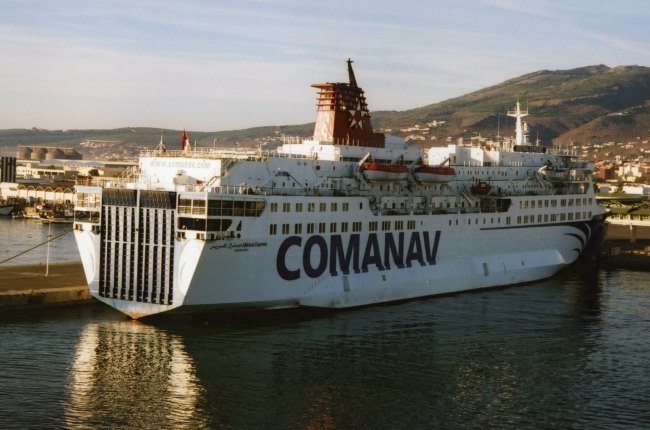
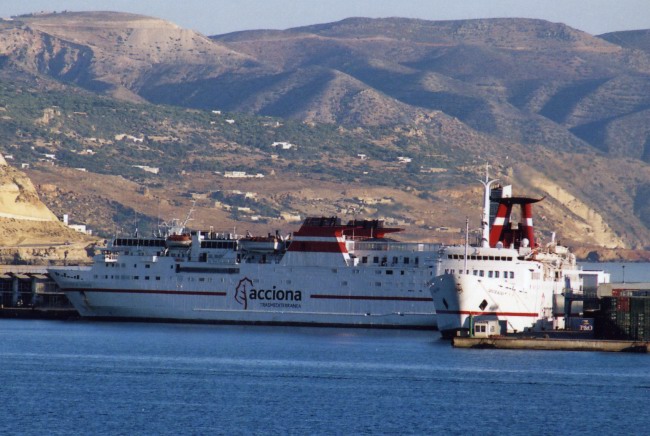
| Above and below: Arrival in North Africa with the Mistral Express at Nador (above) and the Santa Cruz de Tenerife and Ciudad de Valencia across the harbour in Melilla (below). |